AI Agents Are Changing How Work Gets Done
For most of the last few years, AI tools have been reactive. You ask a question, you get an answer. You paste some text, you get a summary. But a new wave of AI is emerging that doesn't just respond, it acts. These are AI agents, and they're designed to complete multi-step tasks on your behalf with minimal supervision.
OpenClaw is an open-source framework that lets you build and run your own AI agents. Instead of relying on a single chatbot interface, you can create agents that browse the web, interact with APIs, fill out forms, extract data from documents, and chain together complex workflows.
What Makes an AI Agent Different
A traditional AI chatbot takes one input and gives one output. An AI agent takes a goal and figures out the steps to get there. It can:
- Break a task into subtasks and execute them in order
- Use tools like web browsers, code interpreters, file systems, and APIs
- Make decisions based on intermediate results
- Recover from errors by trying alternative approaches
- Maintain context across a long sequence of actions
Think of it as the difference between asking someone a question and asking someone to complete a project. The agent handles the planning, execution, and error handling.
How OpenClaw Works
OpenClaw provides a modular architecture for building agents. At its core, an agent has three components:
The planner takes your high-level goal and breaks it into a sequence of actions. It uses a large language model to reason about what needs to happen and in what order.
The tool layer gives the agent access to the outside world. This includes web browsing, file reading and writing, API calls, database queries, and custom integrations you define.
The memory system keeps track of what the agent has done, what it's learned, and what still needs to happen. This allows agents to work on tasks that span minutes or even hours without losing context.
Running Your Own Agent
Getting started with OpenClaw requires a few steps:
- Set up the environment with Python and your preferred LLM provider (OpenAI, Anthropic, or a local model)
- Define your tools by writing simple Python functions that the agent can call
- Write a task prompt describing what you want the agent to accomplish
- Launch the agent and monitor its progress through the built-in dashboard
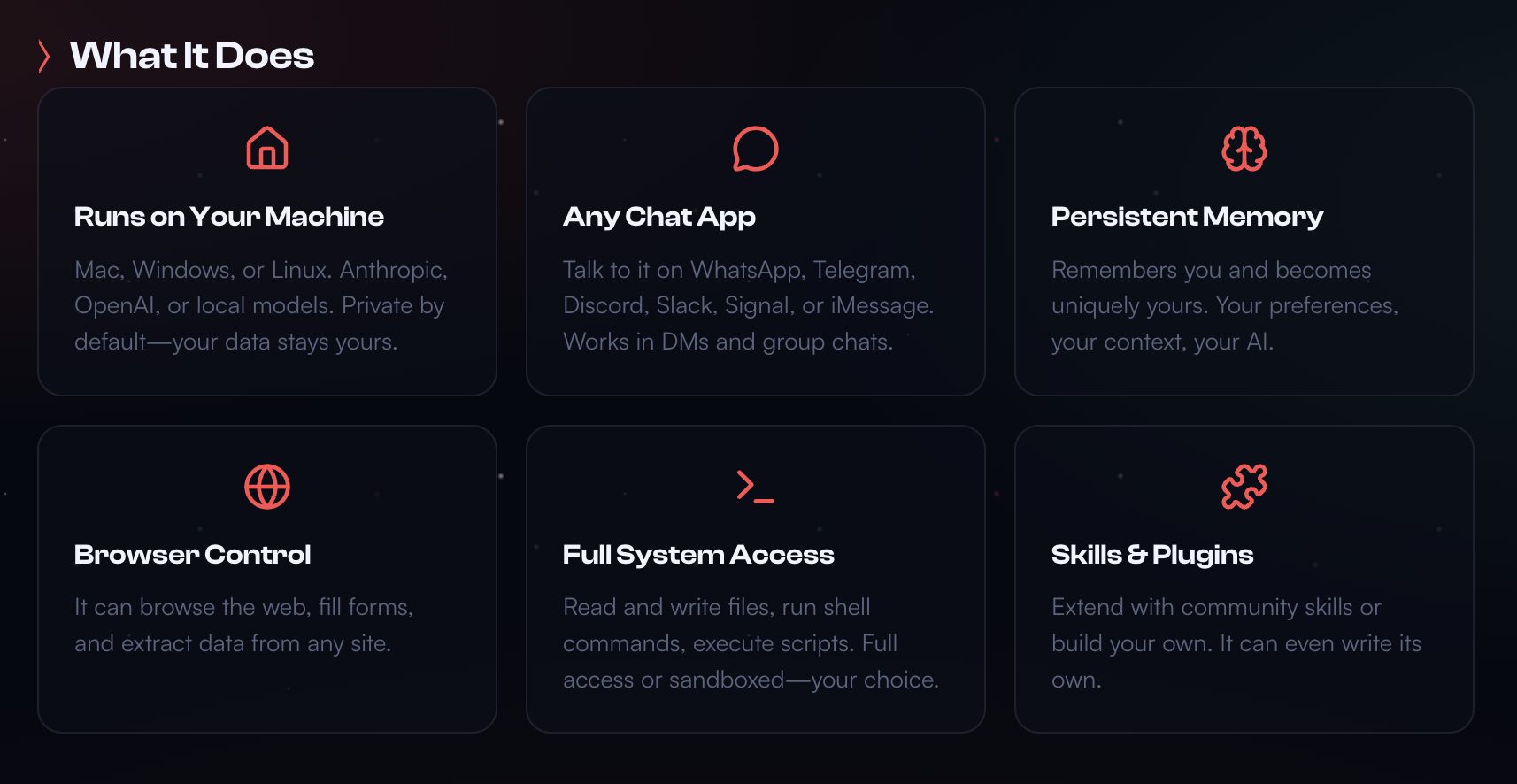
The agent runs locally on your machine, which means your data stays private. You control which tools it has access to and what permissions it operates with.
What You Can Build With AI Agents
The use cases for self-hosted AI agents are wide open:
- Research assistants that gather information from multiple sources and compile reports
- Data processing pipelines that extract, transform, and load data from documents
- Customer support agents that handle routine inquiries and escalate complex issues
- Code review bots that analyze pull requests and suggest improvements
- Monitoring agents that watch dashboards, logs, or feeds and alert you when something changes
Why Self-Hosting Matters
Running your own agent gives you control that cloud-based tools can't match. Your documents, data, and workflows never leave your infrastructure. You can customize every aspect of the agent's behavior, and you're not locked into a single provider's pricing or feature set.
For teams handling sensitive data like financial records, legal documents, or healthcare information, self-hosting is often a requirement rather than a preference.
The Future of Work Is Agentic
AI agents represent a fundamental shift in how we interact with software. Instead of learning a tool's interface and clicking through menus, you describe what you want and the agent figures out how to make it happen. OpenClaw is one of the first frameworks making this accessible to developers and teams who want to build on their own terms.